
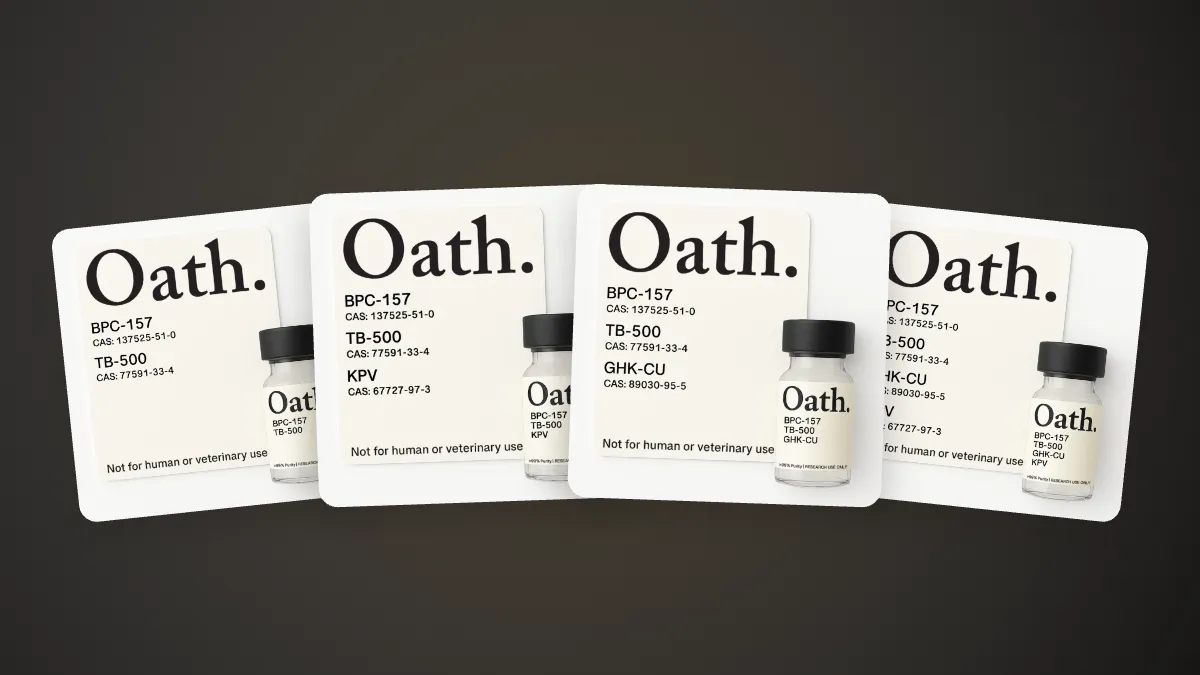
TB-500 blends put TB-500 in one vial with other peptides, most often BPC-157. Oath Peptides sells four of them. They look similar at first, but the ratios and extra ingredients are quite different. This comparison sets out exactly what’s in each one, so you can pick the right vial.
A quick look at TB-500
TB-500 is the synthetic form of thymosin beta-4, a 43-amino-acid peptide that binds actin, one of the most common structural proteins in cells. It’s been studied mostly in animal and cell models of tissue repair. Labs often look at it next to BPC-157, and that pairing is the base of every blend below.
The four TB-500 blends at a glance
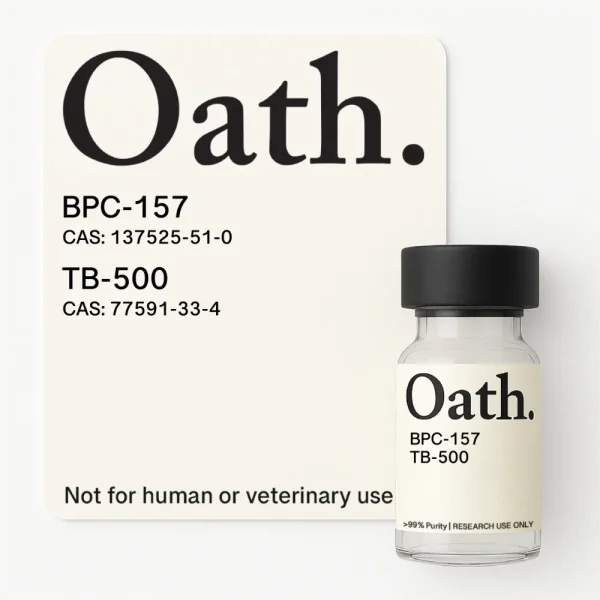
- Wolverine: BPC-157 and TB-500, 1:1. The 10mg vial has 5mg of each, and the 20mg vial has 10mg of each.
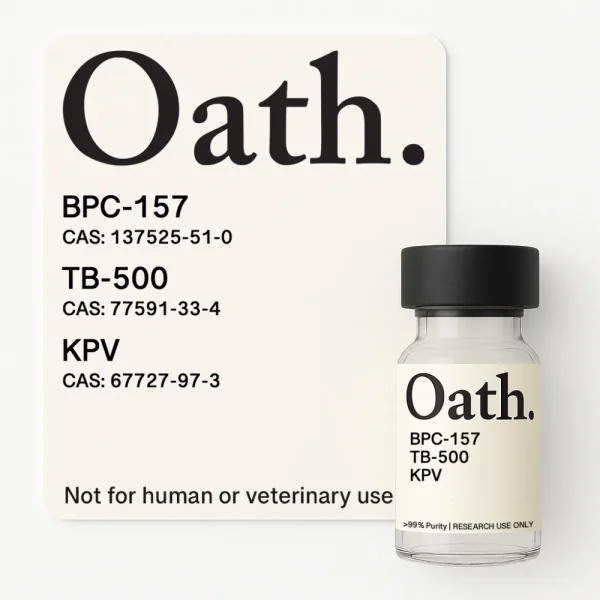
- Wolverine Plus: BPC-157, TB-500 and KPV in equal thirds. 15mg (5mg each) or 30mg (10mg each).
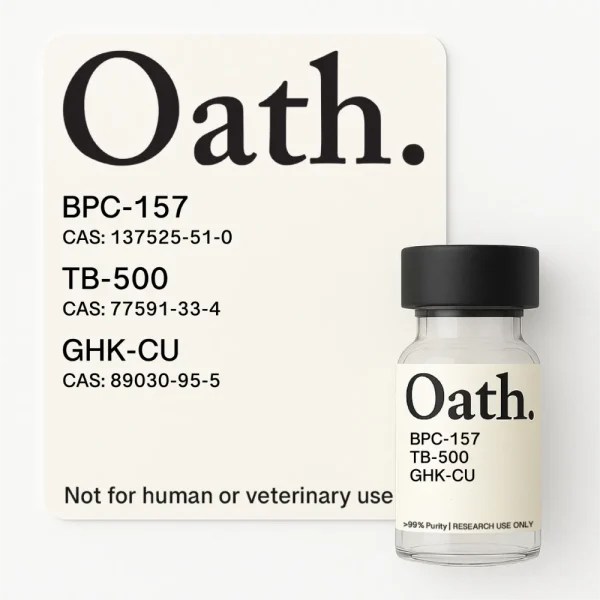
- GLOW: BPC-157, TB-500 and GHK-Cu. The 50mg vial has 5mg BPC-157, 10mg TB-500 and 35mg GHK-Cu. There’s also a 70mg vial.
- KLOW: BPC-157, TB-500, GHK-Cu and KPV. Each 80mg vial has 10mg BPC-157, 10mg TB-500, 50mg GHK-Cu and 10mg KPV.
Which of the TB-500 blends fits your work?
If your protocol only calls for BPC-157 and TB-500, Wolverine is the simplest option. If it adds KPV, the tripeptide from the tail of alpha-MSH, go with Wolverine Plus. GLOW and KLOW are different animals. Most of their weight is GHK-Cu, the copper peptide, so they suit skin and connective tissue work where GHK-Cu is part of the design. Both have a light blue tint from the copper.
If you need a ratio none of these offers, buy the parts separately: BPC-157, TB-500, KPV and GHK-Cu are all sold on their own.
Pros and cons of buying a blend
A blend means one vial to reconstitute, one label and the same ratio every time. The trade-off is flexibility. You can’t change the ratio between experiments. For pilot work, a blend is usually fine. For dose-finding studies, single peptides give you more control.
Storing TB-500 blends
Keep blends in the fridge at 36 to 46 °F (2 to 8 °C) and out of light, especially GLOW and KLOW because of the copper. Reconstitute with Research Water, swirl gently and keep the vial cold.
TB-500 blends and their prices
Blends usually cost less than buying every component on its own, and they save you a reconstitution step. Wolverine is the most affordable of the four TB-500 blends, since it has only two components. KLOW costs the most, but it replaces four separate vials. All four come in 3, 6 and 12 packs that save 10 to 20 percent per vial, and the current prices are on each product page.
For the published research behind each component, start with thymosin beta-4 on PubMed.
All four TB-500 blends
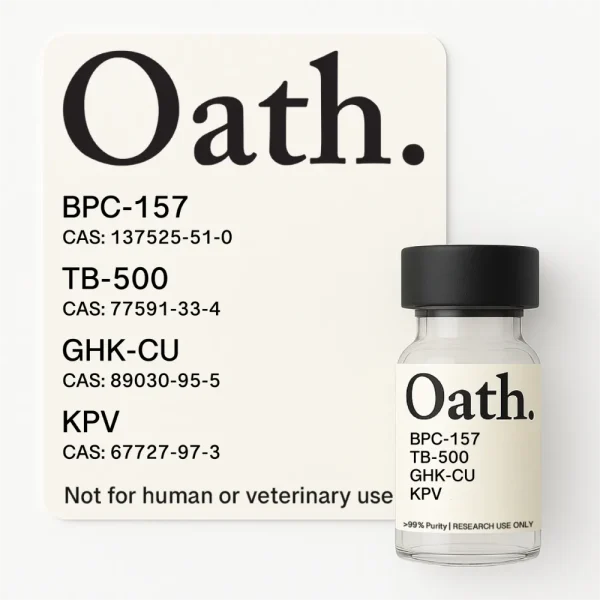
Shop TB-500 blends
Wolverine, Wolverine Plus, GLOW and KLOW, all US lab tested and shipped in 2 days.
TB-500 blends FAQ
Which TB-500 blend has the most components?
KLOW, with BPC-157, TB-500, GHK-Cu and KPV in one 80mg vial.
What’s the difference between Wolverine and Wolverine Plus?
Wolverine is BPC-157 and TB-500. Wolverine Plus adds KPV in equal parts.
Why are GLOW and KLOW blue?
They contain GHK-Cu, a copper peptide, which tints the powder blue.
Related guides
Read the BPC-157 peptide guide and the GHK-Cu guide for more on the blend ingredients, or see every guide on the peptide research blog.
All Oath Peptides products are sold for laboratory research use only. They are not drugs, foods, supplements or cosmetics, and they are not for human or veterinary use.